


What Is Biomedical Health Efficiency?
Biomedical Health Efficiency — BHE — is a measurement framework developed at the Tufts Center for Biomedical System Design through its NEWDIGS consortium. It is designed to answer a question that current health system measurement tools do not ask well: how efficiently is a health system delivering the benefit of a specific biomedical innovation to the patients it was developed to serve?
BHE is disease-agnostic. The same framework — the same underlying methodology and design principles — can be applied to any therapeutic area where a biomedical innovation exists but is not reaching patients at the scale, speed, or equity that the science makes possible. Early Alzheimer’s disease is the first application; others will follow.
In practice, BHE does these things:
|
What BHE does |
How it works in practice |
|
Locates efficiency gaps |
A structured set of metrics — organized across six system readiness domains — that tells you how the delivery system is performing, where it is breaking down, and whether interventions are working. Not a scorecard of intentions, but a measurement of what is actually happening. |
|
Transfers across disease areas |
BHE metrics are developed through a defined process in a specific disease context: identifying the decisions that matter, the decision-makers who own them, the evidence they need, and the data sources that can generate it. That process is what allows the same framework to be applied to any therapeutic area. |
|
Informs solution design |
A way of specifying an efficiency gap during problem elucidation, and of pressure-testing candidate solutions before implementation — requiring each to state which term of the ratio it moves, for whom, and at whose cost. BHE identifies where design effort is needed; the design work itself is a separate step. |
|
Assesses whether solutions worked |
Because the same metrics are tracked before and after a solution is implemented, BHE closes the loop: measure, design, implement, remeasure. Impact is assessed against the same yardstick that identified the gap. |
The three dimensions
BHE defines efficiency as a relationship, not a sum. It asks how much real-world benefit a system delivers — and at what cost in capacity, workforce, and infrastructure. Resources over reach:
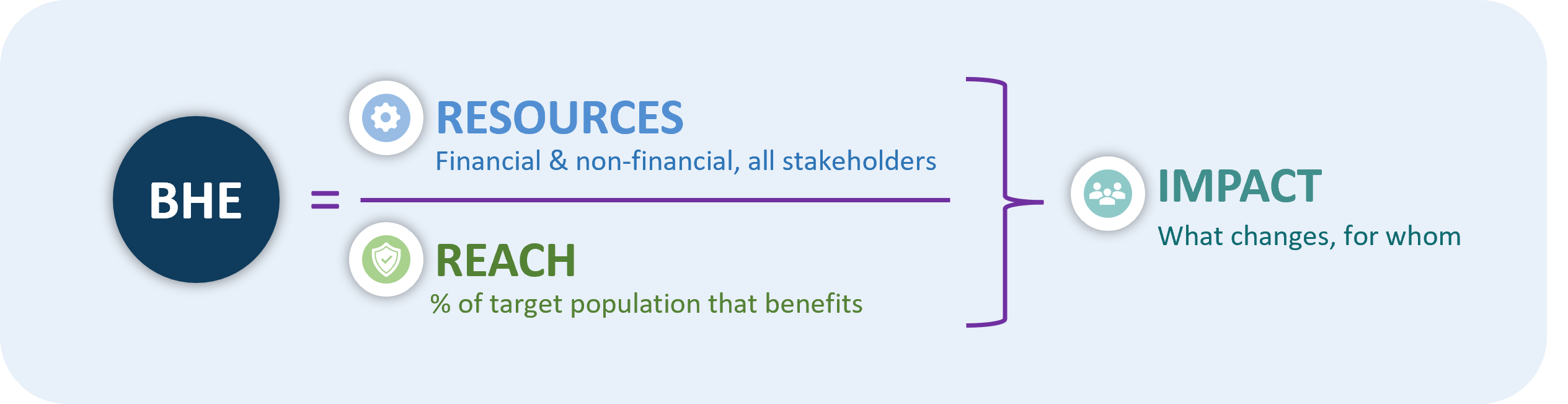
Resources covers everything it takes to deliver an innovation — financial and non-financial, across all stakeholders. Reach is the share of the target population that actually benefits. Together as a ratio they show Impact: what is changing, and for whom.
Why Do We Need It?
Biomedical science is outpacing the systems designed to deliver it. For early Alzheimer’s disease, there are now FDA-approved therapies that can meaningfully slow disease progression in patients diagnosed early — and blood-based biomarkers that make early detection feasible in primary care for the first time. The bottleneck is no longer the science. It is the system.
Fewer than one in five Americans with early-stage Alzheimer’s disease is diagnosed at the stage where these treatments are most effective. Primary care is undertrained. Coverage and reimbursement structures create incentives that suppress early detection investment. The evidence needed to fix these problems at scale — to show what a transformed system looks like, in enough sites and with enough rigor to change policy — does not yet exist.
This gap is not unique to Alzheimer’s disease. It appears across biomedical innovation areas: the science advances, the system does not keep pace, and patients who should benefit do not. The missing piece is almost always the same — a measurement infrastructure that is fit for the purpose of driving system change, not just describing it.
Why conventional measurement falls short
The most powerful health metrics in history — HbA1c for diabetes, viral load for HIV, the 90-90-90 cascade — share a common feature: they were designed to organize systems, not just measure them. Each one told a specific decision-maker something specific they could act on. Each one was embedded in an accountability structure that gave it leverage.
Most measurement efforts for complex health challenges fall short of this organizing power for a simple reason: they measure what is convenient to collect rather than what decision-makers actually need. The result is data that is rigorous but inert — fit for a journal article, but not fit for the coverage decision, the guideline update, or the clinical pathway redesign that would actually change practice.
BHE is built on a different discipline. Every BHE metric is designed backward from the decisions that drive system change — the payer coverage decision, the professional society guideline, the health system operational choice, the regulator’s pathway. If no named decision-maker can act differently as a result of the metric, it does not belong in the core set. This is what makes BHE fit for purpose rather than merely fit for publication.
How BHE Metrics Are Developed
BHE metrics are not selected from a list of available data or borrowed from existing quality measure sets. They are designed — systematically, from the decisions backward — through a process that the NEWDIGS consortium has developed and refined over nearly two decades of applied work in biomedical system design.
The six readiness domains
Every health system that delivers a biomedical innovation must be ready across six interconnected domains: Learning, Standards, Workforce, Payment, Delivery, and Access. These are the six domains of the Biomedical System Readiness framework — the organizing architecture for BHE. The two are related but not equivalent: the six domains describe the capabilities a system needs in order to convert innovation into patient benefit, while BHE measures the result those capabilities actually produce. Readiness is what gets built; BHE is how we know whether it is working.
The domains matter because system failures are almost always multi-domain. A diagnostic test can become available (Standards), be covered by payers (Payment), and still not reach patients — because the primary care workforce is not trained to use it (Workforce), because the care pathway has not been redesigned (Delivery), or because the infrastructure for cross-site learning does not exist (Learning). BHE metrics are designed to span all six domains, so the evidence base speaks to the full system rather than just the parts that are easiest to measure.
The design process
For each domain, the BHE development process asks three questions in sequence:
|
# |
Question |
What it produces |
|
1 |
What are the key decisions — made within this domain — that determine whether patients receive timely, appropriate, and equitable access to care? |
A named decision and a named decision-maker for each candidate metric area. No decision, no metric. |
|
2 |
What evidence would meaningfully improve those decisions — and what is currently missing? |
A specific evidence gap that the metric is designed to fill. This is the test of whether the metric is needed at all. |
|
3 |
What metric — if tracked — would generate or proxy that evidence, and from what data source? |
A metric specification anchored in a feasible data source, phased by what is measurable now versus what requires new infrastructure. |
This three-step traceability — from decision to evidence gap to metric to data source — is what distinguishes BHE metrics from conventional quality measures. Every metric in the BHE framework has a documented justification: not ‘this is a good thing to measure’ but ‘this is the metric that will improve this specific decision for this specific decision-maker.’
Design principles
Six principles govern BHE metric design across all disease applications:
- Anchor every metric in a named decision. If no one can act on the number, it does not belong in the core set.
- Build a cascade as the communication layer. A small number of cascade-shaped metrics maps performance across the end-to-end care continuum — exposing where the pipeline breaks, for which populations, and in which settings.
- Treat equity stratification as a core feature, not an add-on. Every cascade and core metric is reported disaggregated by race, ethnicity, geography, payer type, and other relevant dimensions.
- Stage metrics by data readiness. Phase 1 metrics are computable from existing data. Later phases require infrastructure that is being built. Phasing prevents aspirational metrics from displacing actionable ones.
- Design with a quality measure development pathway in mind. The most powerful metrics in health system history achieved systemic leverage by being embedded in accountability structures. BHE metric design keeps this pathway in view from the start.
- Build governance into the framework. Every BHE metric used for accountability has a built-in annual review cycle. The governance structure is empowered to revise or retire metrics that are being gamed or producing unintended effects.
BHE in Action: The Early Alzheimer’s Disease Application
Early Alzheimer’s disease is the first disease area in which NEWDIGS has applied the BHE framework end to end — a proof of concept for the methodology and the foundation for a broader initiative to transform how early AD care is delivered, measured, and improved at scale.
The challenge
The science has cleared a threshold it has not cleared before. Blood-based biomarkers now enable detection of Alzheimer’s disease years before symptoms appear. FDA-approved anti-amyloid therapies can meaningfully slow progression in patients diagnosed at the earliest stages. The system has not caught up.
The BHE project for early AD is building the measurement infrastructure that a transformed system requires: a stakeholder-tested metric framework, a network of pilot sites tracking shared metrics, and a publication making the evidence-based case for what comes next.
The metrics: structure and example
The current working structure, open to refinement through multi-stakeholder input, organizes BHE metrics into three tiers, each serving a different purpose and audience.
Tier 1 (The Cascade) serves as the public communication layer of BHE for early AD: a four-step cascade mapping system performance across the entire care continuum.
|
Step |
What it measures |
Patient journey stage |
|
|
C1 |
Screened |
% of adults 65+ at risk who receive a structured cognitive assessment in primary care in the past 24 months |
Detection |
|
C2 |
Diagnosed |
% of those with a positive screen who reach a confirmed diagnosis |
Diagnosis |
|
C3 |
Care planned |
% of those diagnosed who have a documented care plan including a treatment options discussion |
Care planning |
|
C4 |
Treated |
% of those eligible who choose to initiate treatment within 90 days of diagnosis |
Treatment initiation |
Like HIV’s 90-90-90, the cascade can carry numerical aspirations as the system matures. Initial pilot baselines will establish current state and shape realistic trajectories. Equity stratification applied across every metric ensures that aggregate numbers do not mask the disparities that matter most.
Tier 2 (Core Operating Metrics) focuses on dimensions that pilot sites track alongside the cascade to answer the question: where exactly in the journey is the delivery system breaking? These are the numbers that drive the learning cycle — shared across sites on a common cadence, enabling cross-site comparison and evidence generation.
Tier 3 (Extended Metrics Set) provides additional metrics for specific decision-makers, quality measure development, and policy analysis. These are not required for routine pilot tracking, but available for payers who need cost-avoidance evidence, regulators designing quality programs, or researchers studying longer-term outcomes.
What the initiative will produce
The BHE early AD initiative is building toward five deliverables:
- A stakeholder-tested BHE metric framework — a proposed Phase 1 metric set across all six readiness domains, with each metric traced to a specific decision, evidence gap, and data source.
- An operational feasibility assessment — for each proposed metric, data availability at candidate pilot sites, and at the anchor beta site, a test of whether the metric can be produced as specified and at what operational burden.
- A pilot site recruitment strategy — candidate sites identified and engaged, with a shared protocol and reporting framework ready for launch.
- A policy engagement roadmap — priority policy levers identified and sequenced, with an initial assessment of HEDIS and Stars pathways.
- A published call to action — a peer-reviewed or consortium publication establishing the BHE framework for early AD and making the evidence-based case for the approach.
Validation in the formal sense — demonstrating that a metric performs reliably across sites and consistently across the populations it stratifies — is the phase that follows.
These deliverables are not the finish line. They are the point at which the field will have, for the first time, a stakeholder-tested metric set, a characterized feasibility base, and a published case for what comes next. Full implementation — a functioning Readiness Network, longitudinal data across sites, policy adoption — follows.
How to Engage
BHE is being built with the ecosystem, not for it. The metric set for early Alzheimer’s disease is in active development, and stakeholder input contributed now — on what evidence would actually move your coverage decisions, guideline updates, clinical pathway adoptions, or quality program priorities — shapes the metrics before they are set.
|
Who |
How to contribute |
|
Pilot sites and health systems |
Track the four-step AD cascade plus core operating metrics at your site — contributing to the shared evidence base without overwhelming local operations. |
|
Payers, policymakers, and professional societies |
BHE metrics are being designed to answer the questions your decisions actually require. Your input on what evidence would move your coverage, guideline, or quality program decisions shapes the metrics before they are finalized. |
|
Biopharma sponsors |
Partners with a long-term stake in a transformed early AD care system can support the development of the measurement infrastructure and participate in metric design and validation. |
|
Patient advocates and community organizations |
Equity stratification is a core design principle, not an add-on. Patient and community voices are essential to ensuring the metrics capture what matters to patients and families. |
Contact us: tuftsmcnewdigs@tuftsmedicine.org